Capacitors which were formerly called condensers, were always build with plates of same physical dimensions in order to satisfy Maxwellian electrodynamics and predictable outcome. But asymmetric capacitors are not much discussed in mainstream due to no direct benefit in existing technologies as well as design complexities.
This post derives the capacitance of the asymmetric parallel plate capacitor.
Let there be and parallel plate asymmetric capacitor as shows below in fig 1. The dielectric material be increasing in width like a cone as shown guiding the electric displacement expanding from one plate to another.
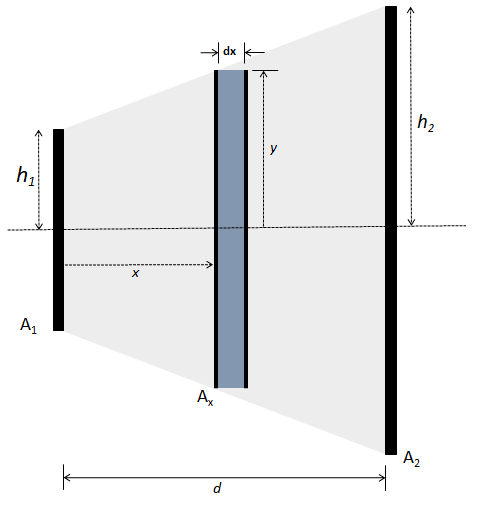
The area of two plates be A1 and A2. Let’s assume them to be squares with sides 2h1 and 2h2 respectively, separated by a distance d. The areas of the two plates are:
\begin{equation}\begin{aligned} A_{1} = 4 h_{1}^{2} \end{aligned}\end{equation}\begin{equation}\begin{aligned} A_{2} = 4 h_{2}^{2} \end{aligned}\end{equation}
To calculate the capacitance, let’s take a small section of the dielectric at distance x from A1 with its height y from the horizontal line making the imaginary plate size as 2y and the separation between them as dx. The area of the abstract symmetric parallel plate capacitor as Ax.
We need to calculated the capacitance of the imaginary small subtract capacitance element and add all of them in series in order to get the actual capacitance.
From similarity we have,
\begin{equation}\begin{aligned} \frac{h_{2} - h_{1}}{d} = \frac{y - h_{1}}{x} \end{aligned}\end{equation} or, \begin{equation}\begin{aligned}y = h_{1} + \frac{x}{d}\left( h_{2} - h_{1} \right)\end{aligned}\end{equation}
Now area Ax is:
\begin{equation}\begin{aligned} A_{x} = 4 y^{2} \end{aligned}\end{equation}or, \begin{equation}\begin{aligned}A_{x} = 4 \left[ h_{1} + \frac{x}{d}\left( h_{2} - h_{1} \right) \right]^{2} \end{aligned}\end{equation}
So, capacitance dCx of the parallel plate capacitor is:
\begin{equation}\begin{aligned} dC_{x} = \frac{\epsilon A_{x}}{dx} \end{aligned}\end{equation} or, \begin{equation}\begin{aligned} dC_{x} = \frac{4 \epsilon \left[ h_{1} + \frac{x}{d}\left( h_{2} - h_{1} \right) \right]^{2}}{dx} \end{aligned}\end{equation}
So total capacitance C in series becomes:
\begin{equation}\begin{aligned} \frac{1}{C} =\int_{0}^{d}\frac{1}{dC_{x}} = \int_{0}^{d}\frac{dx}{4 \epsilon \left[ h_{1} + \frac{x}{d}\left( h_{2} - h_{1} \right) \right]^{2}}\end{aligned}\end{equation}
Now replacing,\begin{equation}\begin{aligned} h_{1} + \frac{x}{d}\left( h_{2} - h_{1} \right) = u\end{aligned}\end{equation} \begin{equation}\begin{aligned}dx = \frac{d}{\left( h_{2} - h_{1} \right)} du\end{aligned}\end{equation} The integral becomes \begin{equation}\begin{aligned} \frac{1}{C} & = \frac{d}{4\epsilon}\int_{h_{1}}^{h_{2}} \frac{du}{\left( h_{2} - h_{1} \right) u^{2}} \\& =\frac{d}{4\epsilon \left( h_{2} - h_{1} \right)} \left[ \frac{1}{h_{1}} -\frac{1}{h_{2}}\right] \\& =\frac{d}{4\epsilon h_{1} h_{2}} \end{aligned}\end{equation}
Hence, \begin{equation}\begin{aligned}C & = \frac{4\epsilon h_{1} h_{2}}{d} \\& = \frac{\epsilon \sqrt{A_{1}A_{2}}}{d} \end{aligned}\end{equation}
So as you can see, for a parallel plate capacitor, A1 = A2 and the above equation becomes
\begin{equation}\begin{aligned} C = \frac{\epsilon A}{d} \end{aligned}\end{equation}